If material selection and heat treatment represent the art of blade manufacturing, grinding is the microscopic art that ultimately determines blade life.
Blade grinding involves far more than simply shaping a blade. The blade material establishes only its theoretical maximum service life; its actual surface topography is created by countless microscopic cutting traces left by the abrasive grains in the grinding wheel.
At the micron—and even submicron—scale, grinding forms the cutting edge, influences surface stresses, and either creates or eliminates microscopic defects. These factors directly affect cutting accuracy, durability, and service life. Grinding is therefore an invisible yet highly precise form of microscopic craftsmanship.
The quality of a ground cutting edge directly influences cutting burrs, cut-edge flatness, and blade life. Consequently, the abrasive material, grit size, grade, and structure of a grinding wheel can profoundly affect blade flatness, surface finish, and even the metallurgical microstructure of the surface layer.
To significantly improve knife surface quality, the grinding process must be carefully controlled to:
· Eliminate microcracks along the knife cutting edge.
· Produce the optimum edge radius.
· Control residual stresses in the surface layer
· Control knife surface texture and roughness
· Prevent grinding burns and thermally affected layers on knives.
Typical Application
rough-semi-finish-finish for knives
Original criterion of Industry Department
#25-#60
#60-#100
#100-#240
#240-W20
Reachable surface coarseness
Ra0.8
Ra0.8-Ra0.4
Ra0.4-Ra0.2
Ra0.2-Ra0.05
Brown fused alumina offers moderate hardness, high toughness, and good heat resistance. Rough grinding for the raw knife materials generally uses relatively coarse grit sizes, such as 46 to 60 grit. Vitrified bonds and open structures are commonly selected to provide high porosity and efficient chip clearance.
Brown fused alumina is suitable for rapid stock removal when a large machining allowance is required. Although it provides high grinding efficiency and makes blade flatness relatively easy to control, it produces a comparatively poor surface finish. The resulting surface has a higher Ra value and clearly visible grinding marks.
Brown fused alumina is primarily used for rough grinding of ordinary carbon steel blades and low-alloy tool steel knives such as 9CrSi knives. It can quickly remove heat-treatment scale and excess material. However, if it is used directly for finishing grinding, the rough cutting edge can increase friction during shearing, causing burrs on the processed material.
White fused alumina is harder than brown fused alumina. Its abrasive grains have extremely sharp cutting edges, although the material is comparatively less tough. Medium grit sizes, such as 80 grit, are commonly used for finish grinding.
Its excellent self-sharpening ability and relatively low grinding temperature in proper knife grinding use help prevent localized tempering, grinding burns, and microcracks when grinding high-alloy and high-speed steel knives. White fused alumina can produce excellent knife flatness and a high-quality knife surface finish.
Blades ground with WA wheels have fewer microscopic edge defects. During shearing, the highly finished cutting-edge surface reduces adhesion and friction between the blade and the workpieces, improving blades’ wear resistance and reducing edge chipping.
Pink fused alumina is produced by adding chromium oxide to white fused alumina. It combines high hardness with improved toughness and provides excellent cutting-edge retention. Fine grit sizes, such as 100 grit, are commonly used.
This wheel can offer the blade an extremely smooth, mirror-like finish while maintaining good flatness and parallelism tolerances, and then helps preserve the blade’s geometric accuracy and minimize distortion.
PA grinding wheels are excellent tool sharpening wheels, particularly suitable for premium heat-treated blades made from die and tool steels. Engineered for grinding high-speed steel to HRC 56 and above. The exceptionally smooth blade surface enables cleaner, flatter-cut edges on workpieces when shearing stainless steel or thin sheet, significantly reducing burrs and extending continuous operating time.
Grinding-wheel characteristics
Made from diamond abrasives, a resin bond, additives, and an aluminum substrate, this product is formed through hot-press curing. As the resin matrix gradually wears, dulled diamond grains are released, continuously exposing fresh cutting edges. This self-sharpening action reduces glazing and loading while delivering flexible, consistent grinding performance. Ideal for grinding tungsten carbide blades.
Effect on blade characteristics
During TCT blade surface grinding, the diamond wheel's elastic resin matrix yields slightly to absorb impact forces, thereby minimizing chipping of the tungsten carbide blade edge and grinding-induced microcracks. This offers the blade cutting edge excellent resistance to chipping.
This wheel is designed for grinding ultra-hard materials; the low grinding force produces minimal heat. This significantly reduces the risk of thermal burns and protects the cobalt binder phase from heat damage. The resulting cutting edge is sharp while maintaining excellent edge straightness and micro-flatness.
It also delivers a superior surface finish with fine, uniform grinding marks, enabling direct machining of blade edge surfaces to achieve fine roughness.
Effect on operating performance
The ultra-high surface finish of the blade surface reduces cutting resistance during paper processing, while its exceptional sharpness ensures clean, precise cross-sectional cuts under high-intensity slitting and shearing. By eliminating microscopic edge defects that can cause premature fracture or wear, the nice surface edge delivers significantly longer service life of the blades.
Selecting the correct grinding wheel is definitely an important part of the blade surface process, but optimizing grinding operating parameters is also crucial. Machine operators should pay close attention to these variables:
Where machine and wheel specifications permit, the grinding-wheel peripheral speed can be increased while the blade workpiece speed and longitudinal feed rate are moderately reduced. This combination produces finer, more uniform microscopic grinding marks and an excellent surface finish.
A properly optimized process reduces cutting resistance and frictional heat while helping prevent scratches on the surface of the processed strip.
The abrasive material, grit size, grade, and structure of a grinding wheel directly determine the microscopic geometry, surface-stress condition, and service life of a blade’s cutting edge. The following sections examine grinding-wheel selection and application across three distinct industries—metallurgy, paper production, and food processing—and explain how to optimize the grinding process for each.
Metallurgical industry cutting blades, such as H13-made knives, including hot shear, flying shear, and medium- and heavy-plate shear blades, operate under extremely harsh conditions. During operation, these blades are subjected to enormous mechanical impacts and alternating thermal stresses. These blades are generally large and require substantial machining allowances.
If a wheel with an unsuitable grade or bonding system is selected—such as an excessively hard brown fused alumina wheel—grinding large cross-sections can generate excessive heat.
This heat from grinding may cause hidden secondary hardening on the blade surface, localized grinding burns, or microscopic surface cracks. Under heavy metallurgical impact loads, such cracks can propagate rapidly, resulting in extensive edge chipping or even complete blade fracture.
A medium-soft white fused alumina wheel is generally preferred. Its excellent self-sharpening characteristics reduce heat accumulation. With careful temperature control, it can achieve “cold,” or low-heat, grinding, maintain the stability of the blade’s metallurgical structure, and preserve the toughness and fatigue strength required for frequent heavy-impact loading.
Circular slitting knives used for paper, plastic film, metal strip, and similar materials are precision rotary cutting tools. They are subject to extremely strict requirements for flatness, parallelism, axial runout, and microscopic edge roughness. Their materials must also provide excellent wear resistance and sharpness.
For example, top slitter knives used in high-speed paper rewinders are commonly made from high-speed steel, while thin knives used in corrugated-board slitting machines are often made from cemented carbide.
If a coarse-grit wheel with poor self-sharpening ability is used, the resulting edge may contain microscopic serrations. When the slitting knife rotates at high speed, these microscopic irregularities are transferred directly to the material, causing burrs, tearing, or wavy edges.
Variations in web width or burrs along the paper edge can create uneven tension between layers during high-speed rewinding. This may cause serious quality problems, such as telescoping—where the layers shift laterally, and the roll develops a stepped, tower-like profile—as well as loose rolls and wrinkles.
Poorly ground cutting edges also generate large quantities of paper dust. This not only contaminates the production area but may also become embedded in the ends of paper rolls, adversely affecting subsequent printing and end use.
High-finish grinding wheels should be used, such as fine-grit PA wheels, CBN wheels, or resin- or vitrified-bonded diamond wheels. These wheels can produce a blade surface with an exceptionally smooth, sharp, mirror-finished cutting edge with surface roughness as low as Ra 0.1.
This enables cleanly, burr-free slitting of the paper sides while minimizing loose paper fibers and dust, thereby substantially improving finished paper quality. What's more, reduced frictional heat between the knife and the material also decreases the frequency of knife replacements and significantly extends continuous operating time.
Food-processing blades—including packaging-machine blades, meat-cutting blades, and circular vegetable-slicer blades—are commonly manufactured from martensitic stainless steels such as 3Cr13, 4Cr13, SUS420J2, 9Cr18MoV, SUS440B, and SUS440C.
The principal requirements for these blades include food safety, cleanliness, minimal residue retention, corrosion resistance, and non-stick cutting performance.
Food-processing blades, particularly those used to cut seafood, require a finely ground or mirror-polished surface. A surface roughness of Ra 0.4 or better is commonly required.
As with steel or paper instances, if a coarse-grit grinding wheel is used to process the food blade surfaces, microscopic grooves may remain along the surfaces. These grooves can trap contaminants, promote bacterial growth, and accumulate chloride ions from seawater. Chloride ions can damage the passive film on the stainless steel blade surface, initiating localized pitting corrosion and eventually causing rust.
Fine-grit white or pink fused alumina wheels can produce a food blade surface finish of approximately Ra0.4. Plus, additional polishing can then reinforce a mirror finish, anti-stick performance, and sharpness. The smooth surface reduces cutting resistance and sticking, particularly when processing sugary, oily, salty, or high-moisture foods. It also minimizes the accumulation of food or liquid residues and helps food-processing operations meet applicable hygiene requirements.
When we go back to modern metallurgy and metalworking, and review more detailed practical uses. Efficient sheet and strip cutting depends on metallurgical cutting tools, particularly coil-slitting knives and steel-shear blades. Blade performance directly affects the dimensional accuracy and cut-edge quality of processed metal strip.
However, attention is often focused only on the blade itself—whether the material was selected correctly, the heat treatment was properly performed, and the final machining tolerances were strictly controlled. The effect of grinding on actual blade performance is frequently overlooked.
These knives are widely used on cold-rolled steel, electrical steel, pickling, aluminum, and stainless steel processing lines to slit into narrow strips. Their cutting range may extend from 0.05 mm ultra-thin foil to 25 mm heavy-gauge coil. It always requires straight, tear-free edges while maintaining tight dimensional tolerances.
These blades are used in various heavy-duty shearing machines and must meet extremely demanding requirements for cutting straightness, perpendicularity, and burr control.
These metallurgical blade examples above process materials ranging from ultra-thin foil to heavy-gauge plate while operating in a wide variety of demanding industrial environments. And the steel sheet’s strength, hardness, and physical characteristics are entirely different; the first consideration must be the appropriate selection of blade material, as premium blade materials include D2 and LD cold-work die steels, H13 hot-work die steel, M2 high-speed steel, and cemented carbide, etc.
This is blade material and steel sheet performance matching.
Select the most appropriate and cost-effective blade material by analyzing its alloy composition and heat-treatment requirements and comprehensively evaluating its strength, toughness, wear resistance, red hardness, and suitability for the intended operating conditions.
Good material selection ensures that blades resist edge chipping and rapid wear during high-speed operation, heavy-impact cutting, or high-temperature service. It also prevents substantial production losses caused by frequent shutdowns and blade resharpening and replacements.
The following two industrial cases offered by LCKNIFE demonstrate the practical value of combining high-performance materials with precision grinding technology.
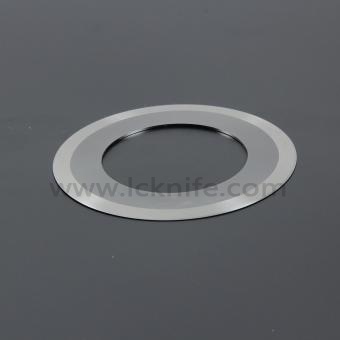
A major structural-steel and sheet-processing company operates a production line for 2 mm galvanized sheet. The line uses D2 cold-work die-steel slitting knives with the size Ø310 × Ø180 × 15 mm.
The knives had an extremely short service life and required frequent replacement and regrinding. The production line had to be stopped every few days to repeatedly resharpen the blade, resulting in significant time wasted on blade adjustments, and that caused substantial losses in production capacity.
Each set of blades could process only approximately 1,000 tons of galvanized sheet. The cut edges also contained burrs, and zinc powder was shed during slitting, increasing the cost of downstream secondary processing.
Although D2 has lower impact toughness than DC53 and LD, D2 blades hardened to HRC 58–60 should be fully capable of cutting 2 mm galvanized sheet. Why, then, did the problem persist?
The Licheng technical team visited the customer and did research there. But spectrometer testing confirmed that the material was D2, Rockwell hardness testing showed a blade hardness of HRC 59, and coordinate-measuring-machine inspection found no dimensional problems. Nevertheless, the same performance issues continued.
Further inspection, when we carefully checked the blade, revealed a poor surface finish on the outer round surface. Instrument testing measured a surface roughness of Ra 1.0, indicating that the grinding method was unsuitable.
The investigation found that brown fused alumina and 46M-grade white fused alumina wheels had been used for grinding blades; they produced a poor surface finish when grinding high-hardness materials. With an excessive feed rate or insufficient coolant, the workpiece’s surface temperature could rise dramatically.
However, D2 is a high-carbon, high-chromium ledeburitic steel with significant carbide segregation. It is particularly sensitive to frictional heat and begins to lose hardness as a cutting blade through tempering at temperatures above approximately 480°C. The practical result is a dramatic reduction in blade life.
Then the LCKNIFE team replaced the customer’s regrinding wheels with 80 grit, K-grade white fused alumina wheels, advised keeping the infeed below 0.01 mm per pass, and performed two or three final spark-out passes to stabilize the surface and minimize thermally induced stress.
Carefully control the grinding temperature to prevent tempering burns and avoid reducing the hardness of the outer round surface. In case of such surface softening, the blades would otherwise be susceptible to microchipping and accelerated wear when cutting galvanized sheet.
Frequently dress the grinding wheel to prevent abrasive dulling, which may cause excessive frictional heat and grinding burns.
After the Licheng team optimized the grinding process, the same slitter knives achieved nearly three times their previous service life. Production capacity increased from approximately 1,000 tons to nearly 3,000 tons per set of the same blade.
Unplanned downtime due to frequent blade resharpening and replacement was significantly reduced. The cut surfaces became smooth and straight, and the edge-chipping and burr problems that had affected the workshop for an extended period were effectively resolved.
A high-tech rolling company specializes in core materials for new-energy motors, including electrical steel laminations and ultra-thin precision aluminum products ranging from 0.05 mm to 2.0 mm thick.
The company has exceptionally strict requirements for the dimensional accuracy and surface roughness of its coil-slitting knives.
Electrical steel is relatively hard and abrasive, while aluminum foil is highly susceptible to edge burrs and friction-induced thermal deformation.
The customer previously used M2 HSS slitting knives. Although the hardness of the blade bodies met specifications, the ground surfaces of the cutting edges and side faces of the blades were insufficiently refined. This resulted in high cutting resistance, extensive microscopic tearing along the cut edges, and an unacceptably high blade-replacement frequency.
The Licheng team improved the finishing process for the slitting knives used in this production line.
Optimize the grinding wheel for slitter blade surfaces. Outer round surfaces and two main surfaces. Replace the wheel with a PA 180# for precision grinding. Its excellent self-sharpening capability effectively prevented burns on the workpiece surface from excessive grinding heat.
Furthermore, lapping the two main surfaces of the blades to achieve a roughness better than Ra0.1, and good control of the flatness and parallelism within 0.001mm.
The grinding-wheel peripheral speed was increased as much as permitted by the wheel and machine specifications, while the blade workpiece speed and longitudinal feed rate were moderately reduced.
Through precision grinding, the countless microscopic abrasive marks on the blade surfaces became extremely fine and uniform, substantially reducing surface roughness.
As a result, cutting resistance and frictional heat were significantly reduced during high-speed slitting of electrical steel and aluminum. Continuous operating time increased by more than 40%.
The processed strip had clean edges without burrs or edge curl, resulting in a substantial improvement in product yield and overall production quality.
Blade material and heat treatment establish the foundation of cutting performance, but precision grinding determines how much of that potential is realized in actual service. Grinding-wheel material, grit size, grade, structure, dressing condition, feed rate, wheel speed, coolant application, and spark-out strategy all influence the microscopic condition of the cutting edge.
For tool knives, whether in metal sheet, paper, or food industries, a properly designed grinding process can eliminate microcracks, control residual stress, prevent thermal damage, improve surface finish, reduce cutting resistance, and significantly extend blade life. Conversely, an unsuitable wheel or poorly controlled grinding process will waste the contributions of even the highest-quality steel and heat treatment.
|
Surface Roughness Comparison of Cross-sectional Grinding |
||||||||||||||||||||
|
China |
Old |
▽14 |
▽13 |
▽12 |
▽11 |
▽10 |
▽9 |
▽8 |
▽7 |
▽6 |
|
▽5 |
|
▽4 |
|
▽3 |
|
▽2 |
|
▽1 |
|
Rz |
0.05 |
0.1 |
0.2 |
0.4 |
0.8 |
1.6 |
3.2 |
6.3 |
10 |
|
20 |
|
40 |
|
80 |
|
160 |
|
320 |
|
|
Ra |
0.012 |
0.025 |
0.05 |
0.1 |
0.2 |
0.4 |
0.8 |
1.6 |
3.2 |
|
6.3 |
|
12.5 |
|
25 |
|
50 |
|
100 |
|
|
Japan |
Old |
▽▽▽▽ |
▽▽▽ |
▽▽ |
|
▽▽ |
|
▽ |
|
▽ |
|
|
|
|
||||||
|
Rz |
0.05 |
0.1 |
0.2 |
0.4 |
0.8 |
1.6 |
3.2 |
6.3 |
12.5 |
|
25 |
|
50 |
|
100 |
|
200 |
|
400 |
|
|
|
Z |
Z |
Z |
Z |
Z |
Z |
Z |
Z |
Z |
|
Z |
|
Z |
|
Z |
|
Z |
|
Z |
|
|
Ra |
0.013 |
0.025 |
0.05 |
0.10 |
0.20 |
0.40 |
0.80 |
1.6 |
3.2 |
|
6.3 |
|
12.5 |
|
25 |
|
50 |
|
100 |
|
|
|
a |
a |
a |
a |
a |
a |
a |
a |
a |
|
a |
|
a |
|
a |
|
a |
|
a |
|
As a professional manufacturer of industrial blades, Licheng integrates advanced materials science, proven heat-treatment technology, precision manufacturing processes, and stringent quality standards into every coil-slitting knife and shear blade it produces.
Ma'anshan Licheng Blade Manufactory


 IPv6ネットワーク対応
 スキャンをwechat: